For a competitive insurance quote, call 0208 255 0617 / 07768 865983 or email your details to quotes@archaeology-insurance.co.uk

Wednesday, 20 January 2016

The world’s first farmers and their slash-and-burn agriculture may have set off global warming.

[....and I've always said that our best hope of surviving the next ice age is global warming.......Ed.]

Published January 20, 2016  FoxNews.com


A new analysis of ice-core climate data, archaeological evidence and ancient pollen samples is being used to suggest farming some 7,000 years ago helped put the brakes on a natural cooling process of the global climate, possibly contributing the warmer climate seen today. 


But the study is expected to raise a few eyebrows, given there were far fewer people on Earth back then and industrialization – and the coal-fired power plants that come with it - was still a long ways off.

A study was the work of an international team led by William Ruddiman, a University of Virginia climate scientist, who first grabbed attention a dozen years ago with a controversial theory that humans altered the climate by burning massive areas of forests to clear the way for crops and livestock grazing. Dubbed the “early anthropogenic hypothesis,” Ruddiman and his colleagues found that that carbon dioxide levels rose beginning 7,000 years ago, and methane began rising 5,000 years ago.

It sparked heated debate back then and continues to be debated among some climate scientists.

In the latest paper, Ruddiman and his 11 co-authors from institutions in the United States and Europe conclude that that accumulating evidence in the past few years, particularly from ice-core records dating back to 800,000 years ago, show that an expected cooling period was halted after the advent of large-scale agriculture. Otherwise, they say, the Earth would have entered the early stages of a natural ice age, or glaciation period.

“Early farming helped keep the planet warm,” Ruddiman said in a statement, regarding the study that appeared in a recent edition of the journal Reviews of Geophysics, published by the American Geophysical Union.

“After 12 years of debate about whether the climate of the last several thousand years has been entirely natural or in considerable part the result of early agriculture, converging evidence from several scientific disciplines points to a major anthropogenic influence,”  he said.

The Earth naturally cycles between cool glacial periods and warmer interglacial periods because of variations in its orbit around the sun. We currently are in an interglacial period, called the Holocene epoch, which began nearly 12,000 years ago.

Call me to discuss your insurance needs on 0208 2550617 / 07768 865983

Monday, 18 January 2016

"Significant" Viking hoard revealed at the British Museum for launch of Annual Treasure Report

 By Richard Moss | 10 December 2015

A Viking Hoard dating from the time of the ‘Last Kingdom’, when the Anglo-Saxon kingdoms of Mercia and Wessex were fighting for their survival against a ‘Great Heathen Army’ of Viking raiders has been revealed at the British Museum.

The valuable hoard, which was discovered by metal detectorist  James Mather in a field in Watlington, Oxfordshire and reported through the Portable Antiquities Scheme (PAS), headed up the launch of the PAS annual treasure report at the museum, which details the thousands of finds reported by detectorists and amateur archaeologists via a network of local museums.

It includes rare coins of King Alfred ‘the Great’ of Wessex (r.871-99) and King Ceolwulf II of  Mercia (874-79), as well as Viking arm-rings and silver ingots, and is said by archaeologists to be nationally significant.

Block lifted in a single slab of earth, the find was excavated at the British Museum. The 186 coins (some fragmentary), seven items of jewellery and 15 ingots were then examined by experts from the museum alongside colleagues from the Ashmolean Museum in Oxford. 

Experts believe the hoard was buried around the end of the 870s, in the period following Alfred’s decisive defeat of the Vikings at Edington in 878, a victory which lead to the unification of England.

Following their defeat, the Vikings moved north of the Thames and travelled to East Anglia through the kingdom of Mercia. It seems likely that the hoard was buried in the course of these events, although the precise circumstances will never be known.

Recalling the experience of finding the hoard and helping excavate it with archaeologists from the PAS, finder James Mather said it was the “icing on the cake of my 60th birthday”.

“It highlights how responsible metal detecting, supportive landowners and the PAS contribute to national archaeological heritage,” he added. “I hope these amazing artefacts can be displayed by a local museum to be enjoyed by generations to come."

If the Watlington Hoard is declared Treasure, the Ashmolean Museum and Oxfordshire Museums Service will be working in partnership with others, and potential funders, to try to ensure it is displayed for local people to learn about and enjoy.

Since 1997, when the Treasure Act became law, the number of finds reported has increased fivefold from 201 cases in 1998 (the first full year of the Act) to 990 in 2013, and 1008 in 2014.

Of the finds reported as Treasure in 2013 (the last year for which figures are available), 363 were acquired by 91 local museums, so they can be displayed close to where the items were discovered.

This year’s annual report reveals that in addition to reported Treasure, a further 113,784 archaeological finds have been recorded by the Portable Antiquities Scheme in 2014.

All of them are recorded on the PAS database (finds.org.uk), where local people can learn about them and discover more about the archaeology and history of their local area.


Call me to discuss your insurance needs on 0208 2550617 / 07768 865983

Monday, 30 November 2015

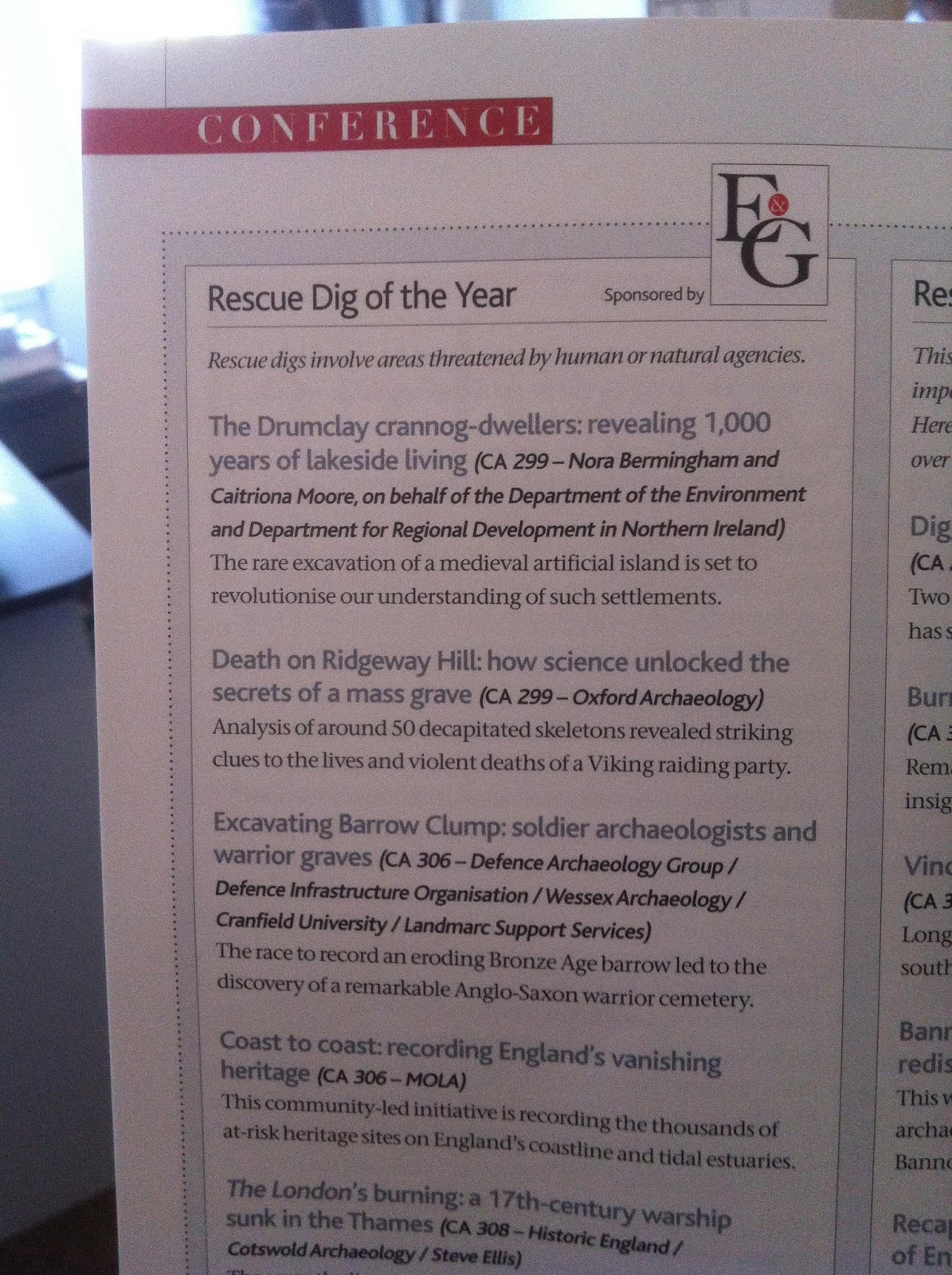
We're in "Current Archaeology"! - Rescue Dig of the Year Event


The 'Conference' section of this month's Current Archaeology features the eagerly anticipated 'Rescue Dig of the Year' event, sponsored by your's truly!

Rescue digs are excavations in areas under threat by human or natural phenomena, and each year archaeologists cross their trowels to compete for a prize which is awarded by E&G.

Current Archaeology are asking you to consider this year's fascinating menu and cast the vote for your favorite dig. We've broken it down here:


The Drumclay Crannog-Dwellers
1,000 years of lakeside living revealed


The excavation of a medieval crannog in Northern Island has prompted comment from Environment Minister Mark H Durkan, who says that the 4,000 object-strong quarry has the potential to "rewrite history". Crannogs are artificial islands constructed in Ireland or Scotland, and crannog excavations reveal significant details about the medieval way of life; Drumclay, however, is of singular importance: "The rich quality of the excavated remains from Drumclay will reshape our understanding not just of this site, but that of crannogs across these islands and medieval settlements in Europe as a whole," Durkan said.


Ridgeway Hill
A scientific analysis of mass graves

The scrutiny of 50 decapitated skeletons buried atop Ridgeway Hill, Dorset, have given scientists a grim insight into the life - and death - of Viking raiding parties. The Vikings were put to death by Anglo-Saxons after the former invaded the British Isles; although the immediate circumstances of death remains unknown, forensic analysts have been able to determine the cause of death. Oxford Archaeology, whose archaeologists commandeered the excavation, sum it up as among the "most exciting and disturbing" discoveries in Britain. The Ridgeway Hill excavations are also among the largest to take place in Dorset to date. 


The Barrow Clump Excavations
A warrior cemetery is discovered in a Bronze Age barrow


Strange objects being kicked out of badger setts is what initially alerted officials to this series of graves in Salisbury Plain, a site now - ironically - under threat by the very same creatures. A plethora of Bronze Age weapons as well as mass graves, decorative beads, brooches and drinking horns were since discovered - making the site one of Britain's most exciting archaeological prospects. Barrow Clump has been subject of interest from the MoD - which fittingly operates a military training ground on the site - and Channel Four's "Time Team", the two having undergone excavations together on a trench. Treasures continue to be uncovered.


England's Coastal Heritage
A community scheme records Blighty's coastal history before it's washed away


Winds, waves and tidal scour are eroding Britain's shores and CITiZAN - MOLA's community-led initiative - has begun the noble task of recording English heritage sites under immediate threat from Mother Nature's wrath. MOLA lists "prehistoric forests, Roman buildings, ancient salt-working sites, lost medieval ports, fishing settlements, coastal defences from both World Wars and countless abandoned boats, barges and ships" as sites of chief concern and has teamed up with such organisations as the Heritage Lottery Fund and the Crown Estate to see the project through. 


17th Century Thames Warship
The remains of an English Warship are preserved by the Thames estuary

A leviathan operation which disturbed The London in her watery tomb found that she was loaded with Reformation-period riches. Funded by "Historic London", hardware such as a well-preserved gun carriage was found on the ship; the item is described as "in near-perfect condition ... a national treasure and the key to new knowledge of our social and naval history" by maritime archaeologist Alison James. Among the highlights of the salvage operation is the 350 year old rope going through the pulley block, which was equally well-preserved because the ship was "enclosed in an anaerobic environment, oxygen-free mud, safe from all the creepy-crawlies that would normally erode it."


The Fenwick Treasure
A Roman jewellery hoard dating to the Boudiccan War of Independence


Our final contender is that of a hoard of Roman jewelry found in Colchester. Thought to belong to a well-to-do woman during the sacking of the city by Bouddica's army, the collection includes two armlets, coins, earrings and rings. It has been described as "easily one of the best [discoveries of its kind] in the country" by Philip Crummy of the Colchester Archaeology Trust, as well as "nationally important". Found under the Fenwicks department store on a Colchester high street, the treasure trove was subsequently donated to Colchester Museum." 


Current Archaeology readers may vote in the latest issue (January) of the magazine, or online here.

The awards take place on 26-27th February 2016 at Senate House, London.