For a competitive insurance quote, call 0208 255 0617 / 07768 865983 or email your details to quotes@archaeology-insurance.co.uk
Showing posts with label archaeology insurance. Show all posts

Monday, 30 November 2015

We're in "Current Archaeology"! - Rescue Dig of the Year Event


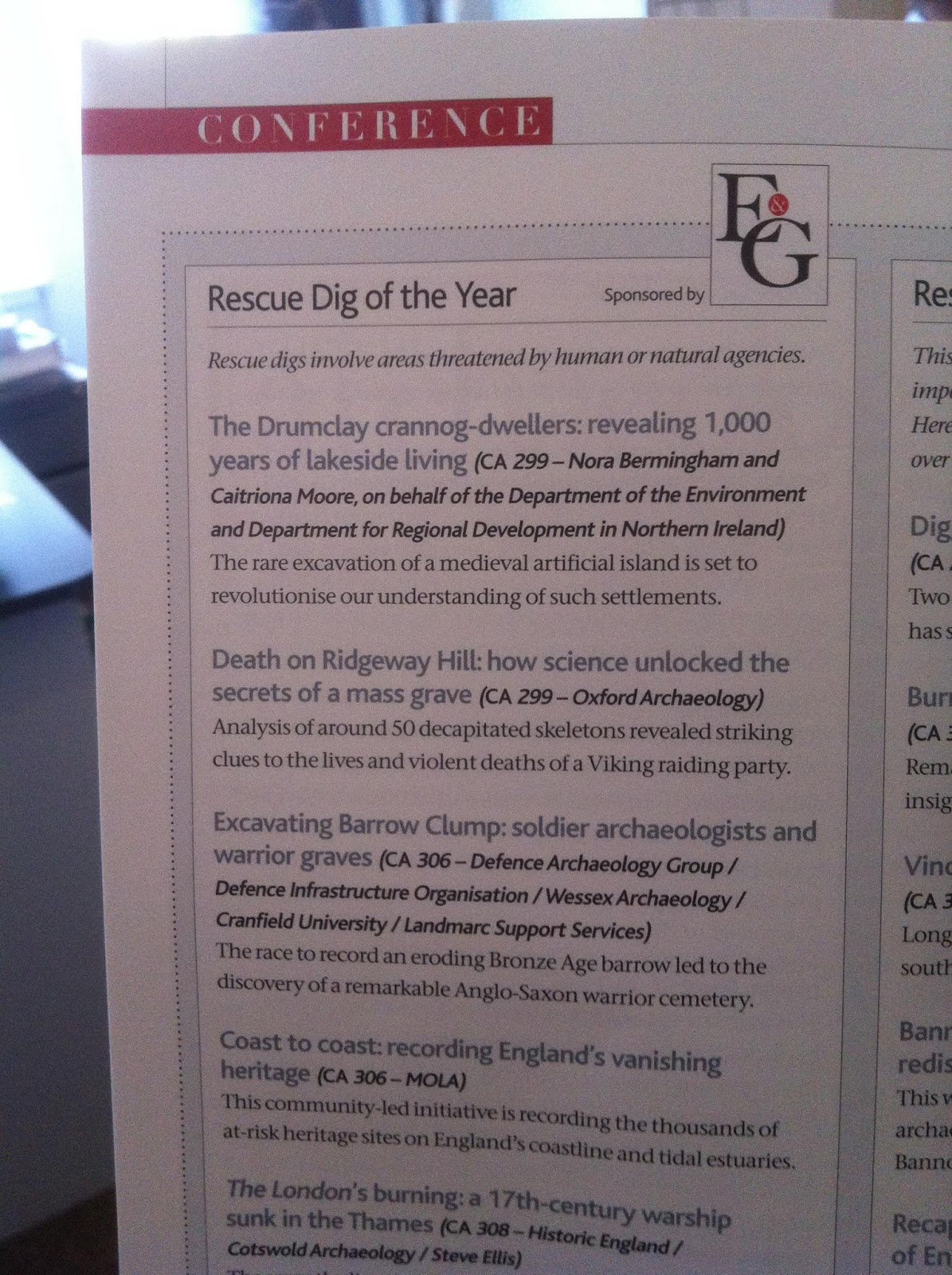
The 'Conference' section of this month's Current Archaeology features the eagerly anticipated 'Rescue Dig of the Year' event, sponsored by your's truly!

Rescue digs are excavations in areas under threat by human or natural phenomena, and each year archaeologists cross their trowels to compete for a prize which is awarded by E&G.

Current Archaeology are asking you to consider this year's fascinating menu and cast the vote for your favorite dig. We've broken it down here:


The Drumclay Crannog-Dwellers
1,000 years of lakeside living revealed


The excavation of a medieval crannog in Northern Island has prompted comment from Environment Minister Mark H Durkan, who says that the 4,000 object-strong quarry has the potential to "rewrite history". Crannogs are artificial islands constructed in Ireland or Scotland, and crannog excavations reveal significant details about the medieval way of life; Drumclay, however, is of singular importance: "The rich quality of the excavated remains from Drumclay will reshape our understanding not just of this site, but that of crannogs across these islands and medieval settlements in Europe as a whole," Durkan said.


Ridgeway Hill
A scientific analysis of mass graves

The scrutiny of 50 decapitated skeletons buried atop Ridgeway Hill, Dorset, have given scientists a grim insight into the life - and death - of Viking raiding parties. The Vikings were put to death by Anglo-Saxons after the former invaded the British Isles; although the immediate circumstances of death remains unknown, forensic analysts have been able to determine the cause of death. Oxford Archaeology, whose archaeologists commandeered the excavation, sum it up as among the "most exciting and disturbing" discoveries in Britain. The Ridgeway Hill excavations are also among the largest to take place in Dorset to date. 


The Barrow Clump Excavations
A warrior cemetery is discovered in a Bronze Age barrow


Strange objects being kicked out of badger setts is what initially alerted officials to this series of graves in Salisbury Plain, a site now - ironically - under threat by the very same creatures. A plethora of Bronze Age weapons as well as mass graves, decorative beads, brooches and drinking horns were since discovered - making the site one of Britain's most exciting archaeological prospects. Barrow Clump has been subject of interest from the MoD - which fittingly operates a military training ground on the site - and Channel Four's "Time Team", the two having undergone excavations together on a trench. Treasures continue to be uncovered.


England's Coastal Heritage
A community scheme records Blighty's coastal history before it's washed away


Winds, waves and tidal scour are eroding Britain's shores and CITiZAN - MOLA's community-led initiative - has begun the noble task of recording English heritage sites under immediate threat from Mother Nature's wrath. MOLA lists "prehistoric forests, Roman buildings, ancient salt-working sites, lost medieval ports, fishing settlements, coastal defences from both World Wars and countless abandoned boats, barges and ships" as sites of chief concern and has teamed up with such organisations as the Heritage Lottery Fund and the Crown Estate to see the project through. 


17th Century Thames Warship
The remains of an English Warship are preserved by the Thames estuary

A leviathan operation which disturbed The London in her watery tomb found that she was loaded with Reformation-period riches. Funded by "Historic London", hardware such as a well-preserved gun carriage was found on the ship; the item is described as "in near-perfect condition ... a national treasure and the key to new knowledge of our social and naval history" by maritime archaeologist Alison James. Among the highlights of the salvage operation is the 350 year old rope going through the pulley block, which was equally well-preserved because the ship was "enclosed in an anaerobic environment, oxygen-free mud, safe from all the creepy-crawlies that would normally erode it."


The Fenwick Treasure
A Roman jewellery hoard dating to the Boudiccan War of Independence


Our final contender is that of a hoard of Roman jewelry found in Colchester. Thought to belong to a well-to-do woman during the sacking of the city by Bouddica's army, the collection includes two armlets, coins, earrings and rings. It has been described as "easily one of the best [discoveries of its kind] in the country" by Philip Crummy of the Colchester Archaeology Trust, as well as "nationally important". Found under the Fenwicks department store on a Colchester high street, the treasure trove was subsequently donated to Colchester Museum." 


Current Archaeology readers may vote in the latest issue (January) of the magazine, or online here.

The awards take place on 26-27th February 2016 at Senate House, London.  

Friday, 20 November 2015

"Witch Girl" exhumed in Italy

Courtesy to Pontifical Institute of Archaeology

The skeleton of a young girl has been disinterred in San Calocero, Italy, and is believed to have been accused as a witch before she was murdered.

The girl - whom scientists determined was severely malnourished at the time of her death, and between the ages of 14-17 - was buried under stone slabs.

The finding was made by Philippe Pergola of the Pontifical Institute of Archaeology and his team, following a like discovery close to the site two years ago of an original "witch girl" who was also malnourished. Both girls are believed to have been the victims of the same macabre ritual.

The burial of the condemned girls - while they were possibly still alive - may have followed such tribulations as burning and being swung by the elbows. The fact that the recovered body's head was almost touching its breastbone suggests that the girl may have also been thrown into the pit.

Both skeletons are dated between the ninth and fifteenth centuries, when suspicion of witchcraft was a fixture of life in parts of the continent.

Thursday, 9 July 2015

Another reason to buy your insurance now!

Sadly, you can’t book and pay for next year’s insurance now!  If you could, you would be saving yourself 3.5% of additional tax.


Call me to discuss your insurance needs on 0208 2550617 / 07768 865983

Tuesday, 7 July 2015

What Archaeology Insurance do I need?

As you know, there are many, many different types of archaeologist!  There are also just as many different types of insurance.  Which of these you require of course depends on who you are and what you are doing.  Below I have picked on 4 groups – which might be typical – so that I can give a brief break-down of the insurance options available to them: 
  • Student, travelling to Greece to fulfil their course field-work requirements
  • Local Archaeology / History Society
  • Small commercial excavation / survey business (sole trader or limited)
  • Larger commercial archaeology / heritage business

 Further details of each group:
 
Student, travelling to Greece to fulfil their course field-work requirements
Activities: 4 weeks back-packing, 2 paid weeks excavation work
Insurance you should have: 

  
Local Archaeology / History Society
Activities: monthly lectures, occasional trips, 2 small-scale excavations
Membership: 2 to 150
Other: £2,000 of excavation equipment

Insurance you should have:
  • Employers’ Liability £10m limit – mandatory when utilising volunteers
  • Legal Defence Costs (comes with Employers’ Liability cover)
  • Public Liability / Products Liability £5m limit – protects you from damage to others or their property as a result of your actions


Optional additional insurance covers
  • All risks cover for equipment – in storage, in transit and on-site / at place of work (temporary or permanent) – if you have equipment.  Or you might consider it not worth insuring as you are happy to cover replacement costs….and who would pinch it anyway?  Worth having a look at this link: http://archaeology-heritage-insurance.blogspot.co.uk/2014/12/insurance-for-expensive-archaeological.html
  • Directors and Offices / Trustees Indemnity – to protect your leaders from personal liability for exercising poor judgement on behalf of the group
  • Personal Accident Insurance – a compensatory cover which will pay out to individuals in the event of very serious injury while working on your behalf

  
Small commercial excavation / survey business (sole trader or limited)
Activities: rescue archaeology, usually for local authority
Personnel: 1 – 10 full time, 0 – 10 part time
Vehicles: 1
Office: 3 computers, other contents
Remit: 80% UK, 20% Europe

Insurance you should have:
  • Employers’ Liability £10m limit – mandatory when utilising volunteers
  • Legal Defence Costs (comes with Employers’ Liability cover)
  • Public Liability / Products Liability £5m limit – protects you from damage to others or their property as a result of your actions
  • Office contents – your computers, records and other business equipment


Optional additional insurance covers:
  • Professional Indemnity Insurance – often a requirement for working with local authorities.  This protects you against legal and compensation costs should your advice or abilities be proved to be inadequate
  • All risks cover for equipment – in storage, in transit and on-site / at place of work (temporary or permanent) – if you have equipment.  Or you might consider it not worth insuring as you are happy to cover replacement costs….and who would pinch it anyway?  Worth also you having a look at this link: http://archaeology-heritage-insurance.blogspot.co.uk/2014/12/insurance-for-expensive-archaeological.html
  • Personal Accident Insurance – a compensatory cover which will pay out to employees / volunteers in the event of very serious injury while working on your behalf
  • Commercial motor insurance where applicable


Larger commercial archaeology / heritage business

Activities: rescue archaeology, planning advice, for local authority or construction industry, training and development work with local history society and local education authority
Personnel: 40 full time
Vehicles: 4
Offices:  5, each with 10 computers, other contents
Remit: 60% UK, 40% Europe

Of course, the list includes all options - and maybe some others:
  • Travel Insurance including cover for ‘light manual work’
  • Employers’ Liability £10m limit
  • Legal Defence Costs
  • Public Liability / Products Liability £5m limit
  • Buildings insurance
  • Office contents
  • All risks cover for equipment – in storage, in transit and on-site / at place of work (temporary or permanent)
  • Directors and Offices / Trustees Indemnity
  • Personal Accident Insurance
  • Money and Assault
  • Business Interruption
  • Fidelity Guarantee
  • Commercial motor insurance
  • Professional Indemnity Insurance
  • Cyber  / E-risks insurance

 Guess where you can get ‘fantastic’ quotes for this lot from?


Of course, all insurance purchases are a choice!  The best approach is to have a good search online to see what is out there, discuss with colleagues and contacts the covers which they have and discuss openly with an insurance broker (ie me!) what you do and how you do it.  That way you will have a clear view of what is out there and what you could be insured for / against.  Then the decision is yours..............

(None of the above is definitive!  There is just so much to say (about insurance!!), these are just my opinions.  Please call to discuss.)

Call me to discuss your insurance needs on 0208 2550617 / 07768 865983


Thursday, 30 April 2015

NASA's Messenger probe completes final tour or Mercury - and prepares to enter Mercury's archaeological record

After more than ten years in space and four years orbiting Mercury, Nasa's Messenger mission is set to come to an explosive end.

(Click here to read more).

The spacecraft is expected to crash into the planet's surface at 20:46 BST today after burning its last fuel in a final manoeuvre on 24 April.


According to said Nancy Chabot "It will probably be an oblique crater... because the impact angle will be so steep, so grazing to the surface. But at over 8,000 miles per hour,
it's going to make a crater."


Possibly the craft will be obliterated, but it will certainly make a dent – and future space travelling archaeologists might just wonder what it was that made that crater.  Or maybe not.....Space Archaeology already exists.

http://www.flinders.edu.au/people/alice.gormanTo get an idea of what it is about, it is worth looking up my friend Dr Alice Gorman of Flinders University who is an internationally recognised leader in the emerging field of space archaeology. Her research on space exploration has been featured in National Geographic, the Monocle, and Archaeology magazine.  She is a faculty member of the International Space University's Southern Hemisphere Space Program in Adelaide.

We met when she was researching stone tool and the Aboriginal use of bottle glass after European settlement in Australia. 

"The archaeology of orbital debris, terrestrial launch sites, and satellite tracking stations."

Follow Alice on Twitter @drspacejunk
Click here to see Alice's profile 

You really must click here and watch this video of Alice describing her research to at TEDx Sydney in 2013 – it will open your eyes!  
https://www.youtube.com/watch?v=x5fn-iycWBs


Call me to discuss your insurance needs on 0208 2550617 / 07768 865983
Follow me on Twitter

Wednesday, 22 April 2015

Guess who is off to Waterloo this summer?

"Archaeologists to excavate Napoleonic farmhouse defended by Coldstream Guards in Battle of Waterloo"

Hougoumont farmhouse
The Defence Archaeology Group led by Diarmaid Walshe will be excavating with Prof Tony Pollard's Glasgow University team at the site of Hougoumont  - a key location during the Battle of Waterloo.

James Gramam
Hougoumont is a cluster of 12 buildings situated in woodland directly below the main position selected by the Iron Duke to break up the advance of the French infantry.  As the battle reached a critical moment, with 14,000 French soldiers on the brink of breaking into the compound and securing victory, Corporal James Graham, a 24-year-old guardsman, closed the large gates of the farm while under fire.  

According to Mark Evans, “Every guardsman from day one in training is told about Waterloo and Hougoumont and what that means to be a Coldstream Guard.”


Mark Evans is a former Coldstream Guards officer, who narrowly escaped death while fighting in Afghanistan, and is a member of the DAG team (as I will be, though my excavation skills are rusty!).


Call me to discuss your insurance needs on 0208 2550617 / 07768 865983

Tuesday, 17 March 2015

Marketing emails are a pain in the neck, but…..


I agree, marketing emails are a pain in the neck.  Like every business we get hundreds every day.  Most are automatically assigned to the “SPAM” folder, but many still arrive in my inbox and I am forced to give them a cursory glance.  It is only on very rare occasions that there is anything of interest or which is worth following up.

So, I get it!!  Please stop sending marketing emails!

In the run-up to April 1st 2015 we have sent a couple of rounds of emails – very carefully targeted to researched and relevant ‘prospects’ who we know are very likely to be interested in our insurances.  Out of the 800 or so emails sent, only one individual has requested that we stop.  I am sad about this because the individual in this instance is the Secretary of a voluntary archaeology group which survives purely on monies donated – and we could have saved them money on their insurances this year………but they are not to know that.

If there was another way, I would use it, but there isn’t! 

Apologies if our emails have clogged-up your inbox or annoyed you – I appreciate that insurance is boring, dull, uninteresting and also a pain in the neck……except when it comes to making a claim…..and choosing your supplier isn’t all about price, but about existing relationships too. 

Anyway there is still time for us to get you an insurance quote in time for your April 1st renewal.  Junk emails or no junk emails, our prices are very competitive this year and you won’t regret getting to know us a little bit better. 

We are very committed to UK archaeology and we want to do our best for the groups that support it!

 Please call me to discuss your insurance needs on 0208 2550617 / 07768 865983

Thursday, 12 March 2015

Significant savings on archaeology insurance


Not being one to ‘blow my own trumpet’ – or indeed, our own trumpet – but we have seen an incredible flurry of requests to benchmark the insurances of archaeological groups and businesses.  It seems that April 1st is a very common renewal date!

There has been so little competition in this sector of the insurance market that we believe that prices have been left to rise year-on-year unchecked.  Indeed, one of the most common moans which we hear is related to the size of the ‘brokerage fee’!  Again it seems that this also rises year-on-year.  One comment which we got recently indicated that one archaeology society was paying a fee to their broker which was 30% of their total insurance cost last year!

We don’t add a brokerage fee.  We get paid a commission by the insurer – so when we quote a ‘premium’ it includes insurance premium tax and is the amount you pay.  Nothing more!


Call me to discuss your insurance needs on 0208 2550617 / 07768 865983

Monday, 2 March 2015

Current Archaeology Live 2015 !


What a fabulous couple of days we had at Current Archaeology Live 2015!  We met so many interesting people and heard about so any interesting projects!  

The award we sponsored was won by Chris Stringer and his team – which was fantastic for me personally as Chris Stringer, Simon Lewis and I had crossed paths (not swords) at Boxgrove in the 1990’s – so it was great to catch-up with them again - not that they recognised me in my insurance uniform at first though.


Too many conversations with so many interesting people to remember everyone I'm afraid, but of note, the great Mr Friendship-Taylor (once met, never forgotten) of the Piddington excavations! And Fergus Milton, the magical metallurgist of Butser!  Plus, the many conservation experts who advised me on the positives and negatives of owning a woolly mammoth tooth preserved with a coat of 1970s varnish!  Thanks also to:


Ariel-Cam
Border Archaeology Society
Braughing Archaeology
Derbyshire Archaeolology
South Somerset Archaeology Research Group
Croydon Historical Society
Brighton and Hove Archaeology Society
Oxford Archaeology East
SWAT Archaeology

…to name but a few of the groups represented.  So glad that we were able to make the grey world of insurance applicable to the needs of archaeology!

A BIG THANK YOU TO EVERYONE WHO CAME TO TALK TO US!  WE LOOK FORWARD TO SPEAKING WITH YOU AGAIN SOON AND TO WORKING WITH YOU IN THE FUTURE!!! 

Call me to discuss your insurance needs on 0208 2550617 / 07768 865983

Wednesday, 28 January 2015

The bizarre story of how Tutankhamun’s beard was simply glued back on


A little unconventional – in fact, bizarre!  Such an important and well-known artefact surely cannot be treated in such a way. What a mess!  It seems the botched repair took place last August - and was not done in the conservation lab.  It doesn't make sense. 

Apparently, one 'conservators' present at the repair admitted that glue was ‘inappropriate’, and that the damage was ‘irreversible’.  Clearly there is a gap between the face and the beard, with a layer of yellow glue showing!


According to the BBC:

The blue and gold braided beard on the burial mask of pharaoh Tutankhamun has been hastily glued back on after it was damaged, museum employees say.

But conservators at the Egyptian Museum in Cairo gave differing accounts of the exact circumstances.


Call me to discuss your insurance needs on 0208 2550617 / 07768 865983

Tuesday, 27 January 2015

Archaeology from Bronze Age Stonehenge country helps experts building huge record of prehistoric objects


Archaeologists working on the Micropasts public archaeology project hope to use a set of drawings and notes relating to artefacts from Wiltshire to create 3D models of some of the finest Bronze Age objects ever found in Britain.


Jennifer Wexler, of the British Museum, where the Bronze Age Index set of cards is held, has examined more than 100 casual finds, lost items and objects from some of the famous barrow cemeteries on Salisbury Plain among the collection, providing detailed descriptions of antiquarian metalwork finds from the past two centuries.

[These cards are a fascinating record of the work carried out in a previous century – and remind me of the work I undertook in 1985 at the Alexand Keiller Museum with the late Isobel Smith.  Dr Smith gave me access to a number of artefacts, as well as to all of the original thin-sections of the Group XIX Mesolithic and Neolithic ground stone axes.  At the time, I believe that they were kept in her attic and I was only allowed to look at them with her present. I believe that I did find the source of the XIX implements - and will divulge all one day.......]  


Call me to discuss your insurance needs on 0208 2550617 / 07768 865983
Email quote@archaeology-insurance.co.uk


Thursday, 22 January 2015

Current Archaeology Live - Archaeology Fair 2015


See our entry in the Fair at Current Archaeology Live 2015.  Come and see us at our stall and enter the raffle for some free (and relevant) gifts!


Call me to discuss your insurance needs on 0208 2550617 / 07768 865983

Wednesday, 21 January 2015

Underinsurance! This is important!


Please read this!

Underinsurance is a very serious business.  If you insure your contents – whether it is your home or your business – for £10,000 instead of its true value of £20,000, you might be forgiven for thinking that in the event of a total loss, insurers will pay you £10,000 – as that is the limit you set on the value. 

Actually most insurers will pay NOTHING in this scenario – because they will deem you to have been underinsured and therefore the level / degree of risk at your property was not fully declared by you.  So, knowingly or not, the insurer will deem you to have deceived them and so they will not pay the claim! 

http://en.wikipedia.org/wiki/File:Mobile_phone_timeline.png
Let me give you an example.  Mr Charles, a mobile phone shop owner has stock valued at £80,000, but declares to his insurer that he only has stock valued at £40,000.  Mr Charles feels that it is unlikely that all of his stock will be stolen and even if it is, he will take the risk on the additional £40,000 himself.  To Mr Charles, the additional premium required to insure £80,000 of stock just seems unnecessary.  He can use that money to take his boyfriend out for dinner instead.  Now, the insurance company is only aware of £40,000 of stock and after assessing all of the risks to the business and the premises they and deem the security precautions at the shop to be adequate for that level risk.  However, if they had known that there was £80,000 of stock, they would have looked at the risks to the business differently.

Sadly, while Mr Charles and his boyfriend are having dinner at their favourite restaurant, the shop is burgled and £20,000 of stock is stolen.  Mr Charles thinks, “that’s annoying, but OK as I have insurance cover for up to £40,000 of stock– so not problem, we’ll be fine!”

Unfortunately, the insurer feels that they were insuring a risk about which they were not fully informed.  There was £80,000 of stock on-site – not £40,000.  The premium was therefore priced wrongly, the security measures were inadequate, what else might Mr Charles have kept quiet about?  Mr Charles is deemed to have been knowingly (or unknowingly, it doesn’t really matter) underinsured and insurers might pay him £10,000 if he is really lucky but more likely if they follow the rules, NOTHING!

The insurer isn’t doing anything wrong here – it was Mr Charles’ mistake.   His only recourse is to try to use ‘mis-selling’ arguments – which might work (see below), but there is no guarantee – and it certainly won’t be a speedy resolution.

Add to all of this the fact that Mr Charles will probably have his insurance policy cancelled and he will have trouble persuading another insurer to take on his business risks – because any new insurer must be informed of any previous claims AND whether or not insurance has been withdrawn or declined in the past.

Insurance is expensive and an annoyance, but it is your best friend when you need to make a claim!  Don’t be underinsured – and if you are, either upgrade your cover or be prepared for a fight if you need to make a claim.

This article from the Telegraph online emphasises these points:

THE SIMPLE MISTAKE THAT CAN HALVE INSURANCE PAYOUTS:

A burgled house or a flood can leave victims without possessions or an inhabitable home. However, many of those involved are denied compensation by their home insurer, which may claim that customers have undervalued their possessions on their policy.

Firms claim “underinsurance” to avoid paying victims a penny, the Financial Ombudsman Service warned this week.

The ombudsman said insurers in some cases gave misleading advice to customers when they bought a policy, which led customers to underinsure their home and contents.

Customers are told they are underinsured only when they make a claim, by which time it is too late. In one case, an insurer told a victim of jewellery theft that her policy was void because she had failed to tell them the true value of her possessions. Her jewellery was insured for up to £10,000 under a home contents policy. However, the value of the jewellery stolen was closer to £100,000.

The insurer paid nothing. The victim’s daughter said it had never occurred to her that claiming less than the jewellery’s value would result in the policy being voided. The ombudsman said she was “not properly warned about the consequences of underinsurance” and ordered the insurer to pay £10,000 plus £200 for the trouble caused.

Another couple bought a £50,000 policy for their possessions. The following winter they arrived home to find that the house had been flooded by a burst pipe. Instead of letting the couple claim the maximum amount under their policy, the insurer said it would pay only half.

The insurer’s excuse: underinsurance. It said the couple had not disclosed the full value of their contents so it was entitled to make a lower payment.

The couple said this was outrageous, and the ombudsman agreed. The insurer was ordered to pay £50,000 plus £300 for the distress caused.

A family affected by winter flooding were told their insurer would cover only half of the cost of damage to their six-bedroom house because they were underinsured.

This was after the family had used the insurer’s own valuation calculator when they renewed the policy. However, after the disaster, the loss adjuster said her property had been substantially underinsured.

The ombudsman said the valuation calculator that the family used was not suitable for their property and told the insurer to pay the claim in full


Call me to discuss your insurance needs on 0208 2550617 / 07768 865983

Towergate sale enters final furlong as Cullum and Homer fall behind frontrunners

Insurance publication, Post Magazine reports that…

Peter Cullum and Andy Homer's hopes of reacquiring Towergate look set to be dashed as the broker seeks to bring an end to a lengthy sale process. Cullum and Homer, the founder and former CEO of the broker respectively, are known to have been exploring a bid for the embattled business, however, sources have told Post the duo are now considered rank outsiders as talks continue with US private equity businesses and global broking giant Marsh…

For staff and customers, the roller-coaster trundles along with all of the associated uncertainty.  Becoming part of global broker, Marsh, is probably the most positive outcome, but that will certainly entail UK redundancies as Marsh already has extensive UK operations.

Watch this space as the story unfolds – it seems to be coming to a head pretty swiftly now after months of seemingly rudderless drifting.


Here is an amusing little story here about Towergate and the original retirement of founders Cullum and Homer in 2011 – and a short cartoon. Shame the film seems to have been viewed once and the lost!  Still the picture (left) is a pretty fair representation of the good Mr Cullum and the equally good Mr Homer! 


Call me to discuss your insurance needs on 0208 2550617 / 07768 865983

Tuesday, 20 January 2015

Towergate insurance broker – an major player in the Archaeology Insurance world - receives £1 takover bid from bondholders which will write off £715m of debt

Picture from: http://www.kentonline.co.uk/kent-business/county-news/takeover-bid-for-insurance-broker-30388/ 


To quote from ChrisPrice, “…Troubled insurance broker Towergate is considering a £1 takeover bid from its bondholders which will pay off £715 million of the company’s debt.

The firm, founded by entrepreneur Peter Cullum in 1997, was put up for sale last year after announcing falling profits and a debt burden close to £1 billion……”

All seems to have gone so well for so long, but maybe the good times were built on sand?  Well, certainly debt!  “….a debt burden of nearly £1 billion…”  WOW!  That is huge.  I am sure that they will find a way to ‘trade on’ – but surely price increases are the least that existing clients can expect?  Worrying times for the 4,000 or so staff I imagine.  Not sure how well I’d be able to concentrate with this lot hanging over my head.

Crikey!  A story worth keeping an eye on if you have a policy with them.


Call me to discuss your insurance needs on 0208 2550617 / 07768 865983