For a competitive insurance quote, call 0208 255 0617 / 07768 865983 or email your details to quotes@archaeology-insurance.co.uk

Monday, 20 June 2016

GO DIGGING SUMMER 2016


Look at the Current Archaeology DIGS! Section to make a plan for the summer:

“Nothing beats the excitement of hands-on archaeology, and with the new digging season almost upon us, there is no time to lose.

This is a chance to get practical experience, either before heading off to university, or putting into practice what has been studied in theory. But for most, this is simply a glorious way to pass the time.

Our guide covers the full gamut of locations, periods, and types: from fieldwalking to recording and cataloguing, from early Neolithic to Medieval and later there is something for everyone. Some jobs require stamina, but many do not. Young or old, fit or not, time rich or time poor, all you need is enthusiasm and a desire to get involved.”


Call me to discuss your insurance needs on 0208 2550617 / 07768 865983
Email: quote@archaeology-insurance.co.uk

Monday, 18 April 2016

Hope to see you at the CIfA Conference 2016 in Leicester

As an Affiliate member, I will be at the conference from Thursday afternoon until the close of play on Friday meeting lots of friends and former work colleagues.  I had hoped to have a trade stand, but I wasn’t allowed, so here’s my “no-platformed” platform for all to see!


See what you are missing: free pencils, free bottles of water, free photographic scales, free document cases……and vital insurance advice!!! 


Call me to discuss your insurance needs on 0208 2550617 / 07768 865983

Tuesday, 1 March 2016

PRESS RELEASE: Rescue Dig of the Year award for 2016, for Drumclay Crannog Project


Nora Bermingham and Caitríona Moore accept Current Archaeology’s prestigious Rescue Dig of the Year award for 2016, for their work on the Drumclay Crannog

The award for Rescue Dig of the Year (sponsored by Export and General Insurance for the second year running) was accepted by Dr Nora Bermingham and Caitríona Moore who carried out the rare excavation of a crannog (a medieval artificial island) in Co. Fermanagh on behalf of the Department of the Environment and Department for Regional Development in Northern Ireland. The well-preserved remains of timber structures and thousands of artefacts uncovered at this important site, are set to revolutionise our understanding of crannog life.

The prize forms part of the celebrated Current Archaeology Awards given each year by Current Archaeology, the UK’s leading archaeology magazine. TV personality and archaeologist Julian Richards (of Meet the Ancestors fame) announced the winners of the 2016 awards on 26 February, during the Current Archaeology Live! event, held at the University of London’s Senate House, which saw a record number of ticket sales for the conference, and was attended by over 400 people.

Nora Bermingham said:
‘Thank you so much to everyone who voted for us. This was a tiny little rural excavation in Northern Ireland, and we’re thrilled to have won. Doing Drumclay was the experience of a lifetime, and I don’t think it will be matched – it was a real privilege to direct that excavation and see the wonders that came out of it. We had a wonderful crew, and we would also like to thank the Department of the Environment and Department for Regional Development in Northern Ireland.’

John Mitchell said:
We are delighted once again to be sponsoring this prestigious award – and we are very happy that it has been won by the Drumclay Crannog Project.  It is well deserved!
  
Call me to discuss your insurance needs on 0208 2550617 / 07768 865983


Wednesday, 10 February 2016

Stonehenge Findings Reveal Prehistoric Gender Equality


In light of a new study of human remains found at Stonehenge in 2008, researchers suggest that prehistoric Woman was able to attain high status, and may even have been considered the equal of men.

14 of the 23 remains exhumed at Stonehenge - which is believed to have been a cemetery for Wiltshire’s antediluvian movers and shakers - belong to women. According to archaeologists such as Mike Pitts (of British Archaeology), the study should be used to revise notions of male-dominated prehistoric societies that are currently prevalent in the media and the arts.  

The project, Pitts prates, puts paid to painters’ preponderant portrayals of a prominent prehistoric patriarchy:

“In almost every depiction of Stonehenge by artists and TV re-enactors we see lots of men, a man in charge, and few or no women

“The archaeology now shows that as far as the burials go, women were as prominent there as men. This contrasts with the earlier burial mounds, where men seem to be more prominent.

Other researchers concur that the findings demonstrate a “surprising degree of gender equality” given artists’ depictions of the site as being ruled by men “with barely a woman in sight”.


Christie Willis of the University College London Institute of Archaeology was tasked with identifying the sex of the remains which, collectively, weighed some 45kg and have since been sent off to the universities of Oxford and Glasgow to be radiocarbon-dated. 

Thursday, 4 February 2016

Ancestral worm protection could cause lung disease in Viking descendants

In a paper published today in Scientific Reports a group of researchers led by (Liverpool School of Tropical Medicine) LSTM have found that the key to an inherited deficiency, predisposing people to emphysema and other lung conditions, could lie in their Viking roots.

Archaeological excavations of Viking latrine pits in Denmark have revealed that these populations suffered massive worm infestations. The way that their genes developed to protect their vital organs from disease caused by worms has become the inherited trait which can now lead to lung disease in smokers.

Chronic obstructive pulmonary disease (COPD) and emphysema affect over 300 million people, or nearly 5% of the global population. The only inherited risk factor is alpha-1-antitrypsin (A1AT) deficiency, and this risk is compounded if individuals smoke tobacco.
A1AT protects the lungs and liver from enzymes called proteases that are produced by cells of the immune system, but also by parasitic worms. In the absence of A1AT these proteases can break down lung tissue leading to COPD and emphysema.


Deficiency of A1AT is genetically determined and is due to deviants of A1AT that are surprisingly common, particularly in Scandinavia, where they evolved in Viking populations more than two thousand years ago. Why these disease-causing deviants of A1AT are so common in human populations today has long been a mystery.

LSTM's Professor Richard Pleass is senior author on the paper. He said: "Vikings would have eaten contaminated food and parasites would have migrated to various organs, including lungs and liver, where the proteases they released would cause disease."

In this latest paper the authors show that these deviant forms of A1AT bind an antibody called immunoglobulin E (IgE) that evolved to protect people from worms. The binding of A1AT to IgE prevents the antibody molecule from being broken down by such proteases.

"Thus these deviant forms of A1AT would have protected Viking populations, who neither smoked tobacco nor lived long lives, from worms." Continued Professor Pleass, "it is only in the last century that modern medicine has allowed human populations to be treated for disease causing worms. Consequently these deviant forms of A1AT, that once protected people from parasites, are now at liberty to cause emphysema and COPD."


Call me to discuss your insurance needs on 0208 2550617 / 07768 865983


Wednesday, 20 January 2016

The world’s first farmers and their slash-and-burn agriculture may have set off global warming.

[....and I've always said that our best hope of surviving the next ice age is global warming.......Ed.]

Published January 20, 2016  FoxNews.com


A new analysis of ice-core climate data, archaeological evidence and ancient pollen samples is being used to suggest farming some 7,000 years ago helped put the brakes on a natural cooling process of the global climate, possibly contributing the warmer climate seen today. 


But the study is expected to raise a few eyebrows, given there were far fewer people on Earth back then and industrialization – and the coal-fired power plants that come with it - was still a long ways off.

A study was the work of an international team led by William Ruddiman, a University of Virginia climate scientist, who first grabbed attention a dozen years ago with a controversial theory that humans altered the climate by burning massive areas of forests to clear the way for crops and livestock grazing. Dubbed the “early anthropogenic hypothesis,” Ruddiman and his colleagues found that that carbon dioxide levels rose beginning 7,000 years ago, and methane began rising 5,000 years ago.

It sparked heated debate back then and continues to be debated among some climate scientists.

In the latest paper, Ruddiman and his 11 co-authors from institutions in the United States and Europe conclude that that accumulating evidence in the past few years, particularly from ice-core records dating back to 800,000 years ago, show that an expected cooling period was halted after the advent of large-scale agriculture. Otherwise, they say, the Earth would have entered the early stages of a natural ice age, or glaciation period.

“Early farming helped keep the planet warm,” Ruddiman said in a statement, regarding the study that appeared in a recent edition of the journal Reviews of Geophysics, published by the American Geophysical Union.

“After 12 years of debate about whether the climate of the last several thousand years has been entirely natural or in considerable part the result of early agriculture, converging evidence from several scientific disciplines points to a major anthropogenic influence,”  he said.

The Earth naturally cycles between cool glacial periods and warmer interglacial periods because of variations in its orbit around the sun. We currently are in an interglacial period, called the Holocene epoch, which began nearly 12,000 years ago.

Call me to discuss your insurance needs on 0208 2550617 / 07768 865983

Monday, 18 January 2016

"Significant" Viking hoard revealed at the British Museum for launch of Annual Treasure Report

 By Richard Moss | 10 December 2015

A Viking Hoard dating from the time of the ‘Last Kingdom’, when the Anglo-Saxon kingdoms of Mercia and Wessex were fighting for their survival against a ‘Great Heathen Army’ of Viking raiders has been revealed at the British Museum.

The valuable hoard, which was discovered by metal detectorist  James Mather in a field in Watlington, Oxfordshire and reported through the Portable Antiquities Scheme (PAS), headed up the launch of the PAS annual treasure report at the museum, which details the thousands of finds reported by detectorists and amateur archaeologists via a network of local museums.

It includes rare coins of King Alfred ‘the Great’ of Wessex (r.871-99) and King Ceolwulf II of  Mercia (874-79), as well as Viking arm-rings and silver ingots, and is said by archaeologists to be nationally significant.

Block lifted in a single slab of earth, the find was excavated at the British Museum. The 186 coins (some fragmentary), seven items of jewellery and 15 ingots were then examined by experts from the museum alongside colleagues from the Ashmolean Museum in Oxford. 

Experts believe the hoard was buried around the end of the 870s, in the period following Alfred’s decisive defeat of the Vikings at Edington in 878, a victory which lead to the unification of England.

Following their defeat, the Vikings moved north of the Thames and travelled to East Anglia through the kingdom of Mercia. It seems likely that the hoard was buried in the course of these events, although the precise circumstances will never be known.

Recalling the experience of finding the hoard and helping excavate it with archaeologists from the PAS, finder James Mather said it was the “icing on the cake of my 60th birthday”.

“It highlights how responsible metal detecting, supportive landowners and the PAS contribute to national archaeological heritage,” he added. “I hope these amazing artefacts can be displayed by a local museum to be enjoyed by generations to come."

If the Watlington Hoard is declared Treasure, the Ashmolean Museum and Oxfordshire Museums Service will be working in partnership with others, and potential funders, to try to ensure it is displayed for local people to learn about and enjoy.

Since 1997, when the Treasure Act became law, the number of finds reported has increased fivefold from 201 cases in 1998 (the first full year of the Act) to 990 in 2013, and 1008 in 2014.

Of the finds reported as Treasure in 2013 (the last year for which figures are available), 363 were acquired by 91 local museums, so they can be displayed close to where the items were discovered.

This year’s annual report reveals that in addition to reported Treasure, a further 113,784 archaeological finds have been recorded by the Portable Antiquities Scheme in 2014.

All of them are recorded on the PAS database (finds.org.uk), where local people can learn about them and discover more about the archaeology and history of their local area.


Call me to discuss your insurance needs on 0208 2550617 / 07768 865983

Monday, 30 November 2015

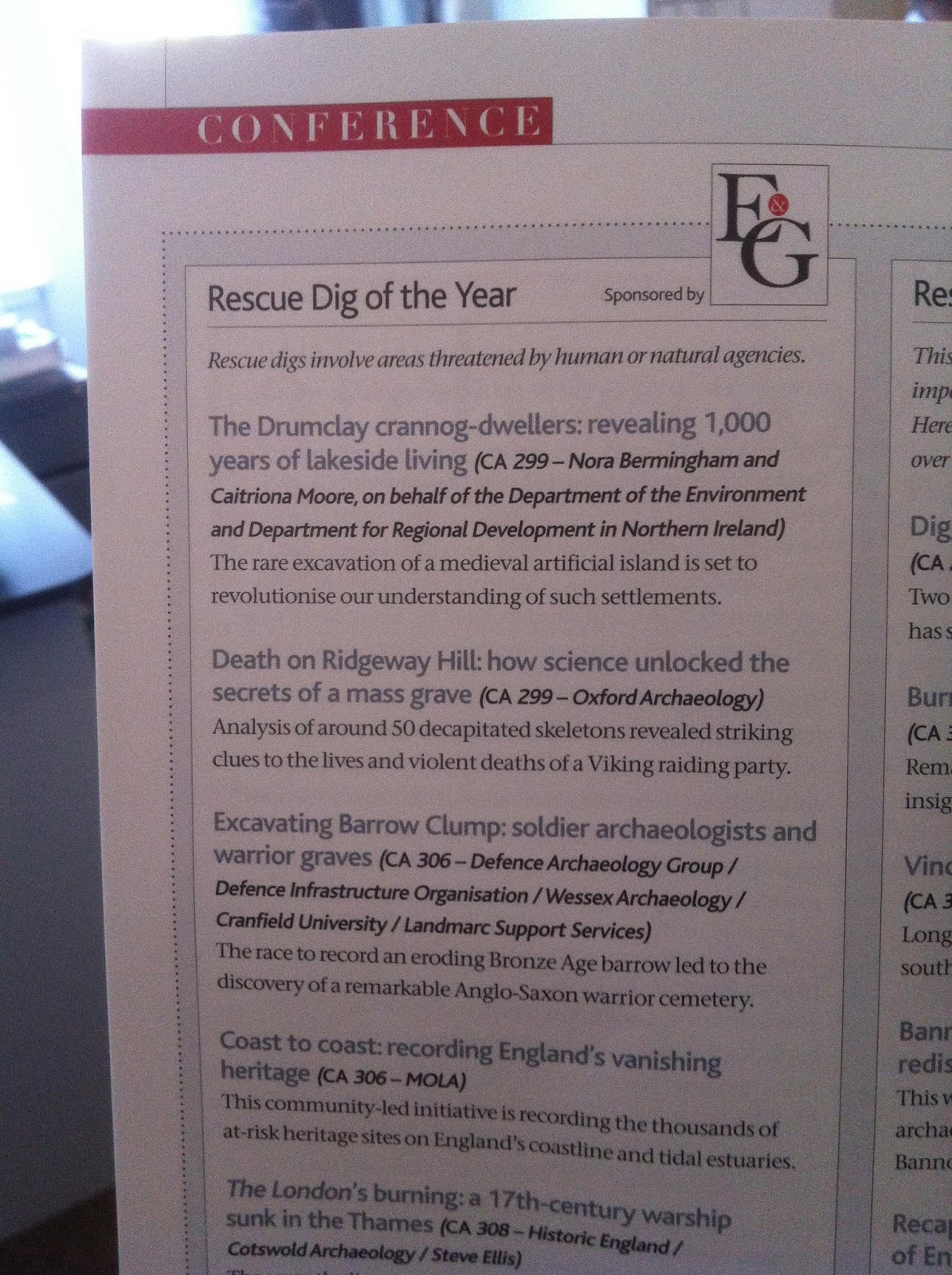
We're in "Current Archaeology"! - Rescue Dig of the Year Event


The 'Conference' section of this month's Current Archaeology features the eagerly anticipated 'Rescue Dig of the Year' event, sponsored by your's truly!

Rescue digs are excavations in areas under threat by human or natural phenomena, and each year archaeologists cross their trowels to compete for a prize which is awarded by E&G.

Current Archaeology are asking you to consider this year's fascinating menu and cast the vote for your favorite dig. We've broken it down here:


The Drumclay Crannog-Dwellers
1,000 years of lakeside living revealed


The excavation of a medieval crannog in Northern Island has prompted comment from Environment Minister Mark H Durkan, who says that the 4,000 object-strong quarry has the potential to "rewrite history". Crannogs are artificial islands constructed in Ireland or Scotland, and crannog excavations reveal significant details about the medieval way of life; Drumclay, however, is of singular importance: "The rich quality of the excavated remains from Drumclay will reshape our understanding not just of this site, but that of crannogs across these islands and medieval settlements in Europe as a whole," Durkan said.


Ridgeway Hill
A scientific analysis of mass graves

The scrutiny of 50 decapitated skeletons buried atop Ridgeway Hill, Dorset, have given scientists a grim insight into the life - and death - of Viking raiding parties. The Vikings were put to death by Anglo-Saxons after the former invaded the British Isles; although the immediate circumstances of death remains unknown, forensic analysts have been able to determine the cause of death. Oxford Archaeology, whose archaeologists commandeered the excavation, sum it up as among the "most exciting and disturbing" discoveries in Britain. The Ridgeway Hill excavations are also among the largest to take place in Dorset to date. 


The Barrow Clump Excavations
A warrior cemetery is discovered in a Bronze Age barrow


Strange objects being kicked out of badger setts is what initially alerted officials to this series of graves in Salisbury Plain, a site now - ironically - under threat by the very same creatures. A plethora of Bronze Age weapons as well as mass graves, decorative beads, brooches and drinking horns were since discovered - making the site one of Britain's most exciting archaeological prospects. Barrow Clump has been subject of interest from the MoD - which fittingly operates a military training ground on the site - and Channel Four's "Time Team", the two having undergone excavations together on a trench. Treasures continue to be uncovered.


England's Coastal Heritage
A community scheme records Blighty's coastal history before it's washed away


Winds, waves and tidal scour are eroding Britain's shores and CITiZAN - MOLA's community-led initiative - has begun the noble task of recording English heritage sites under immediate threat from Mother Nature's wrath. MOLA lists "prehistoric forests, Roman buildings, ancient salt-working sites, lost medieval ports, fishing settlements, coastal defences from both World Wars and countless abandoned boats, barges and ships" as sites of chief concern and has teamed up with such organisations as the Heritage Lottery Fund and the Crown Estate to see the project through. 


17th Century Thames Warship
The remains of an English Warship are preserved by the Thames estuary

A leviathan operation which disturbed The London in her watery tomb found that she was loaded with Reformation-period riches. Funded by "Historic London", hardware such as a well-preserved gun carriage was found on the ship; the item is described as "in near-perfect condition ... a national treasure and the key to new knowledge of our social and naval history" by maritime archaeologist Alison James. Among the highlights of the salvage operation is the 350 year old rope going through the pulley block, which was equally well-preserved because the ship was "enclosed in an anaerobic environment, oxygen-free mud, safe from all the creepy-crawlies that would normally erode it."


The Fenwick Treasure
A Roman jewellery hoard dating to the Boudiccan War of Independence


Our final contender is that of a hoard of Roman jewelry found in Colchester. Thought to belong to a well-to-do woman during the sacking of the city by Bouddica's army, the collection includes two armlets, coins, earrings and rings. It has been described as "easily one of the best [discoveries of its kind] in the country" by Philip Crummy of the Colchester Archaeology Trust, as well as "nationally important". Found under the Fenwicks department store on a Colchester high street, the treasure trove was subsequently donated to Colchester Museum." 


Current Archaeology readers may vote in the latest issue (January) of the magazine, or online here.

The awards take place on 26-27th February 2016 at Senate House, London.  

Thursday, 26 November 2015

E&G Picks: Exciting New British Museum Exhibition

Iron Age shields
© The Trustees of the British Museum
A new exhibition starts on Britain's most important archaeology finds opens soon at the British Museum.

Silver coins dating to the 3rd century AD
© The Trustees of the British Museum
The display is comprises hundreds of objects including Roman coins, ceramic pots and - perhaps most saliently - a magnificent Frome hoard pot.

The pot itself was swollen with 52,503 coins when it was found in Somerset in 2010, and promises to be the centerpiece of a fine array of archaeological trinkets, which were described in an article by Culture24 a few days ago.

Bronze Age weapons discovered in the River Thames will also make an appearance, as will the first Iron Age coin hoards; all of the objects have been subject to extensive study at the British Museum.

Together, they not only symbolises Britain's rich history, but also the success of her laws: the Treasure Act of 1996 obliged treasure hunters to report their discoveries, and this potentially superb exhibition owes itself to the act.


Roman ceramic money box, with coins and a spoon
© The Trustees of the British Museum


What: Hoards: The Hidden History of Ancient Britain
Where: The British Museum, London
When: December 3 2015 – May 22 2016.


Wednesday, 25 November 2015

Glastonbury's Monk Marketers


For centuries a mystical atmosphere has swirled around Glastonbury Abbey, which is said to be the resting place of King Arthur and Queen Guinevere.

Since the 12th century, the Abbey has been one of Britain's most sacrosanct destinations for pilgrims and monks; but archaeologists have discovered that it's part in British myth may be more contrived than previously thought. 

In fact, the whole Glastonbury origin myth may have to be rewritten after surveys conducted by Reading University conclusively established that no remains belonging to Arthur or Guinevere are buried on the site. 
This leaves open the possibility that the site's monk custodians were actually medieval Mad Men, who invented the myth in a bid to raise funds after a fire destroyed the site in 1184. 

It goes without saying that their mythopoeic marketing strategy was an overwhelming success, and so firmly entrenched Glastonbury Abbey in British folklore that the site's popularity has endured to the modern day. Cynical monks, however, are no match for science's quest for truth.

The group of archaeologists whose project resulted in the findings say that despite the prospect of "the history of Glastonbury Abbey [being] rewritten", tourist numbers will not dwindle. 

Likewise, site director Janet Bell insists that the report does not "debunk King Arthur's affiliation with the Abbey", and even hints at the possibility of using it as another marketing opportunity. 

Her predecessors would have been proud. 

Export & General's friends at C&N Hollinrake Ltd, consultant archaeologists, are situated in Glastonbury, and devote some of their time to ecclesiastical archaeology. You can visit their website here. 

Friday, 20 November 2015

"Witch Girl" exhumed in Italy

Courtesy to Pontifical Institute of Archaeology

The skeleton of a young girl has been disinterred in San Calocero, Italy, and is believed to have been accused as a witch before she was murdered.

The girl - whom scientists determined was severely malnourished at the time of her death, and between the ages of 14-17 - was buried under stone slabs.

The finding was made by Philippe Pergola of the Pontifical Institute of Archaeology and his team, following a like discovery close to the site two years ago of an original "witch girl" who was also malnourished. Both girls are believed to have been the victims of the same macabre ritual.

The burial of the condemned girls - while they were possibly still alive - may have followed such tribulations as burning and being swung by the elbows. The fact that the recovered body's head was almost touching its breastbone suggests that the girl may have also been thrown into the pit.

Both skeletons are dated between the ninth and fifteenth centuries, when suspicion of witchcraft was a fixture of life in parts of the continent.

Wednesday, 18 November 2015

'Martian Archaeologist' finds Face Carved in Pyramid

The YouTube channel "Martian Archaeology" has singled out a sphinx's face on a pyramidal rock formation on Mars - calling the photographs produced by NASA conclusive evidence of an ancient civilisation.

The 'Martian Archaeologist's' peculiar avocation involves scouring through NASA photo archives in an attempt to uncover convincing evidence of extraterrestrial life.

The photos in question were taken by the famous rover Curiosity which has hitherto found no evidence of life at all - even on a microscopic level. In recent months, however, evidence collected by Curiosity indicates that water may once have existed on Mars. The US Space Agency even suggested that large oceans may even have existed on the planet's surface.

But Martian Archaeology still isn't satisfied, and says that the NASA photo of the sphinx is part of a larger body of evidence which proves beyond doubt that an ancient civilisation once thrived on Mars.

We remain unconvinced.
Not many people purport to be able to explain the origin of the sphinx-face. Much less the mysterious red circle.

Tuesday, 17 November 2015

E&G Picks: New Exhibition Unveiled in China

A museum in north China's Hebei Province has unveiled a new exhibition consisting of ancient Buddhist statues and fragments, many of which are over 1,500 years old.

Having documented an excavation in Mes Aynak, Afghanistan of priest-king and buddhist statues (click here), the news from Hebei has made E&G staff particularly excited.

So much so that we've dispatched a member of our team on tour in China - we hope he'll be visiting the Hebei Province museum and report back to us.


For specialist insurance for archaeologists, click here.

Monday, 16 November 2015

Breaking News: Europeans are Descendants of "Fourth Tribe"

Modern Europeans are the genetic descendants of a recently discovered "fourth tribe", researchers have confirmed.

It was thought that Europeans are a mix of three distant populations: hunters; Middle Eastern farmers and easterners who arrived during the Bronze Age.

But Nature Communications has revealed that genetic material retrieved from a skeleton in the Caucasus points towards a fourth population which has contributed to the European gene pool. 

Genomes harvested from burial sites thanks to scientific advances has meant that more data about ancient humans can be collected - altering our conception of our genetic legacy. 

The 10,000 year old Georgian skeleton, from which the data was collected

Of the three tribes previously thought to have been the exclusive ancestors of modern Europeans, the hunter-gatherers were the first to arrive in Europe before the Ice Age.

The migration of Middle Easterners 33,000 years hence shifted the genetic paradigm and introduced agriculture to Europe. 4,000 years later the Yamnaya - a herder people whose genetic contribution is concentrated most voluminously in the modern Norwegian population - entered Europe from the Steppes.

This groundbreaking discovery means researchers are likely to be puzzling over where the "fourth tribe" fits into the genetic story of Europe for quite some time yet.

CBA South-East Conference and AGM

We attended the CBA South-East Conference and AGM on Saturday – where we met some very interesting people and had a fantastic time!

While we didn’t attend the lecture sessions, the feedback we got from those who did was fantastic!

Professor Martin Bell (University of Reading) - The Mesolithic of the Wetland and Coastal Edge in Southern Britain
Phil Jones (Surrey County Archaeology Unit) - Mesolithic Remains at Bletchingley and Mesolithic Surrey
Garry Momber (Hampshire and Wight Trust for Maritime Archaeology) - Mesolithic Technology at Bouldnor Cliff: Was it 2,000 Years Ahead of its Time?
Mike Donnelly (Oxford Archaeology) - New Mesolithic Discoveries on the Bexhill Relief Road Scheme, Kent
Dr Fraser Sturt (Uni. Southampton) and Dr Duncan Garrow (Uni. Reading) - Stepping Stones to the Neolithic: Seafaring, Connectivity and the Mesolithic/Neolithic Transition
Dr Jodie Lewis (University of Worcester) - Caves, Springs and Depositing Things: Approaching the Mesolithic and Neolithic in the South West
Dr Rick Schulting (University of Oxford) - Violent Times in the Neolithic? A Review of the British Evidence
Don Henson (University of York)  - Public Engagement in the Mesolithic and Neolithic

All good stuff.  Click here to read more

Just about everyone there (with a few exceptions) pulled a Christmas cracker with us too!

From our point of view, we found yet again that there is a great deal of interest in our insurance services - and we were able to provide quotes 'on the spot' for a number of individuals, local societies and commercial businesses.  Of course we will be following up all of those enquiries in the coming days - and getting some new clients on cover! 


As for the location – the Surrey History Centre – well, that was also fantastic!  What a great resource – and what a change from the usual look and feel of the county records office!


Call me to discuss your insurance needs on 0208 2550617 / 07768 865983

The Chinese Lamps That Swallow Smoke

What's the most curious thing unearthed in archaeology this week?

The smoke lamp: A goose-shaped Chinese contraption designed to 'swallow' smoke produced by the burning of wax, which is consequently dissolved by water in its belly.

Two such lamps were this week discovered by archaeologists in China. Dating back to the Western Han Dynasty (roughly 221 - 206 BC) and made of bronze, they preempt the eco-friendly craze by roughly 2200 years - and could teach modern Chinese a thing or two about environmental awareness. 

Bronze lamps were a staple of the Han Dynasty, but these smoke absorbent ones are the first such discovered of their kind. Xin Lixiang, who led the excavation, says that the discoveries are set to change existing conceptions of Han industry.  

The fact that none have been discovered before makes this story particularly - ahem - absorbing; the findings hint at an element of exclusivity in Western Han society. It is likely that the increased production of bronze lamps reduced their price, encouraging more innovative variations of bronze lamps to be devised. 

The ingenious nature of the smoke lamps doesn't stop there. The ability to adjust the brightness of the lamp, a feature not even universally present in modern lamps, was enabled through the use of swinging shades. Furthermore, the whole lamp could be dismantled according to the anatomical parts of the goose, in order that it be preserved and maintained. 

And as with many ancient Chinese innovations, function is complemented by form - which typically draws on beguiling natural imagery:

"It is both an artwork and an example of ancient innovation," said Lixiang, who spoke to Chinese news agency Xinhua. 

The finding was made in a cemetery - Hailhunhou - in Jiangxi Province, itself an archaeological discovery dubbed the most "complete Western Han Dynasty cemetery" yet discovered in China by ancient-origins.net. 

Excavations at the site first began in 2011, and the lamps symbolise the promise of new discoveries yet to be made. 


Chartered Institute for Archaeologists membership!

At last my membership pack from the Chartered Institute for Archaeologists has arrived!  I might only be an Associate, but it is a start!

I realise that the CIfA is not loved by everyone across the archaeology sector in the UK - and I understand why – but at least it is something of a central hub for archaeology professionals.

I look forward to gathering further opinion at the CIfA annual conference in April next year…..presuming that as an Associate member, I am invited…..and not banned again this year from attending by CIfA’s only insurance partner……


Call me to discuss your insurance needs on 0208 2550617 / 07768 865983

Tuesday, 3 November 2015

Gloucester Cathedral - a political dynasty beneath your feet


Bones under the ledger stone

The unexpected discovery of an 8ft deep family burial vault in the North Transept of Gloucester Cathedral is a fascinating story for me.

Many of us have trodden over the ledger stones at Gloucester and elsewhere and wondered what is beneath.  As a child, I hoped that there was nothing underneath and that the actual burial was elsewhere – perhaps a way of persuading my 12 year old self that ‘morning chapel’ wasn’t taking place surrounded by dead bodies!

Now, of course, I love the idea of an intricate network of tunnels and rooms under the floor – most yet to be discovered.

The ledger stone

From the news reports the family name was Hyett – I can see on the ledger:

Also
Benjamin Hyett & Elizabeth w…
daughter of Joseph Morwent
He dyed 1711 aged 62
She dyed 1708 aged 55
also their children
.. 1692 ..
.. 1706 ..
.. 1712 ..

And from on of the coffin lids:

Frances Hyett
Daughter of
…ny Hyett and Fran Hyett
Died Feby 16 1748?
Aged 9 Months

Inside the vault

A very brief scan of the internet shows a Charles Hyett (1677 or 1686 to 1738)  who had two sons - Benjamin Hyett II (1708 to 1762) and Nicholas Hyett (1709 to 1777). 

Charles’s father is recorded as Benjamin Hyett (1651 to 1711) who I think is our man – so at least one of Benjamin and Elizabeth’s children survived. 

Charles was MP for Gloucester between 1722 and 1727 and built Painswick House “to escape the smog of Gloucester” but he died not long after moving there.

Robins' painting
Benjamin II inherited Painswick House where he created the now famous Painswick Rococo Garden which was painted by Thomas Robins the Elder in 1748.

Nicholas was a lawyer and Justice of the Peace and one of “the last keepers and constables of the Castle of Gloucester”. 

Both Nicholas and Benjamin II failed in their attempts to follow their father’s footsteps into Parliament, but a long line of later descendants were more successful in this endeavour.

Press reports show Richard Clavering Hyett Dickinson (Lord Dickinson) as the living relative – and the grandson of Willoughby Hyett Dickinson, 1st Baron Dickinson of Painswick, who, like his ancestor Charles (and probably many other Hyetts)  was an MP. 

Painswick House
Back to the story, I think that I heard in a radio interview the new bishop of Gloucester – the Rt Rev Rachel Treweek- talking about renovations to the Bishop’s Palace and the installation of a new kitchen. Clearly her ‘new broom’ extends to the North Transept renovations and the installation of a lift – which is how this great discovery was made.

It is only by remaining current and fit for purpose in our ever-changing world that our great buildings will survive – and to survive, they need to do what they have always done – change!

My final hope is that the plan is to record the vault by camera and then close it up and leave the Hyetts just as they are.

Call me to discuss your insurance needs on 0208 2550617 / 07768 865983